






Foreign Exchange Program
The IFYE Experience - The Adventure of a Lifetime!
Imagine driving a rice harvester in Thailand, or helping market strawberries in Finland, or helping to make wine in Austria. These are only a few of the opportunities you may experience by participating in IFYE's international exchange program.
The IFYE foreign exchange program offers you an opportunity to experience another way of life by living it; IFYE is truly a “learn by doing” experience. It's your chance to see new places, make new friends, and soak in another culture. You'll join in all aspects of family life -- sharing quiet moments, enjoying family outings, and joining community activities as well as helping with household and family chores. It is an adventure that will pay off for the rest of your life, especially in your chosen career. There is no other experience like IFYE, and it can be truly life changing. Our alumni are farmers and ranchers, other business owners, corporate leaders, elected officials, teachers and university professors, authors, scientists, publishers, and leaders in many other professions.
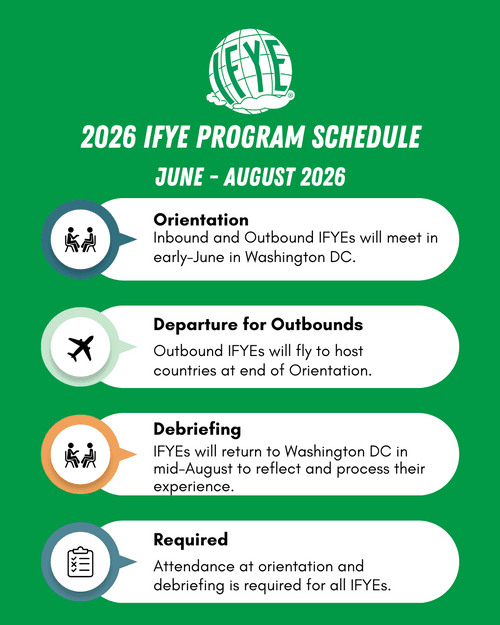
The IFYE foreign exchange program is for individuals 19 and older and may last two, three, or six months. As a participant in the program, you'll live and work as part of the family. You'll also move to a new family every three to five weeks, so you're able to gain a broader perspective about life in your host country.
There are many different ways that you can become involved with the IFYE program. To learn more about the IFYE foreign exchange experience, contact Traci Ross Sherlock, Interim National Program Director.
What Makes IFYE Unique?
- The family stay experience: While other programs may have family visits and maybe overnight stays, the IFYE host family experience stands out because of the degree of integration you'll experience. You will become part of the family every moment of every day for all types of experiences.
- Types of host families: Host families are screened by IFYE coordinators in each country. The families are prepared to accept you as a family member and not as a tourist who needs to be entertained.
- Multiple host families: You'll have the opportunity to live with multiple host families in each country. This gives you a multi-dimensional view of the host country. Different regions have varying customs, dialects, agriculture, economies, and geography leading to wider understanding of the culture as a whole.
- The age of participants: As a young adult, 19 and above, you have already gained some independence through college or other experiences. This experience helps you be more inclined to see yourself as a member of an ever-expanding world.
- Length of stay: With a two-, three-, or six- month stay*, you'll have time to get over any culture shock and learn and understand the culture in which you're living.
- Total cultural immersion: You'll be completely engaged in the family, community, and culture of the host country.
*Only a three-month program is offered for 2026.
